Unveiling the Differences and Applications in Precision Machining
In the realm of CNC (Computer Numerical Control) machining, two commonly confused cutting tools—ball nose end mills and CNC router bits—play distinct roles in shaping materials, yet they are often mistaken for interchangeable products. While both are designed to remove material with precision under CNC control, their structural designs, functional focuses, and ideal applications differ significantly. This article delves into the core differences between these two tools, exploring their features, uses, and performance characteristics to help manufacturers, machinists, and hobbyists make informed decisions for their specific machining needs.
1. Core Definition: What Are Ball Nose End Mills and CNC Router Bits?
1.1 Ball Nose End Mills
A ball nose end mill is a type of end mill (a cutting tool used in milling machines) characterized by a hemispherical tip at the end of the tool. Its cutting edges extend from the tip along the side of the tool’s flute, allowing it to perform both axial (plunging) and radial (side) cutting. Typically made from high-speed steel (HSS), carbide, or cobalt, ball nose end mills are engineered for precision machining of complex 3D contours, curved surfaces, and fillets.
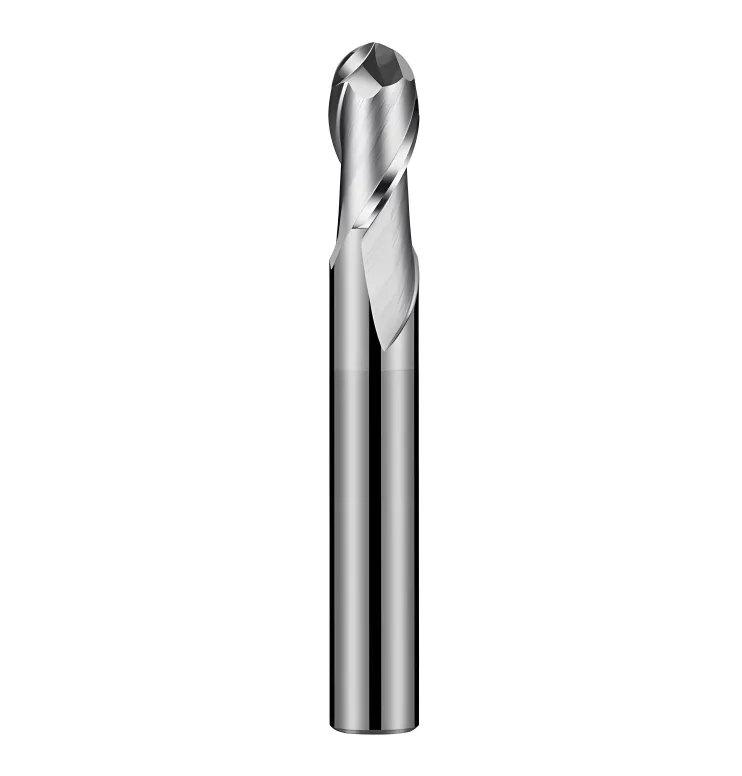
1.2 CNC Router Bits
CNC router bits refer to a broad category of cutting tools specifically designed for CNC routers—machines primarily used for cutting, carving, and engraving softer materials (though some heavy-duty router bits can handle harder substrates). Unlike ball nose end mills, CNC router bits come in a wide variety of tip shapes (straight, spiral, V-groove, flush trim, etc.), and their design is optimized for high-speed, high-feed cutting of non-metallic materials, with some variants adapted for light metal machining.
2. Key Differences: Features and Design
|
Feature
|
Ball Nose End Mills
|
CNC Router Bits
|
|---|---|---|
|
Tip Shape
|
Fixed hemispherical (ball) tip; the radius of the tip matches the tool’s half-diameter, ensuring smooth, curved cuts without sharp edges.
|
Variable tip shapes (straight, spiral, V-groove, ball, flush trim, etc.); ball-shaped router bits are a subset, not the standard.
|
|
Flute Design
|
Typically 2–4 flutes (carbide variants often have 2–3 flutes for chip evacuation); flutes are deep and designed for heavy material removal in metals.
|
Flutes vary by application (1–4 flutes); spiral flutes are common for clean cuts in wood/plastics; flutes are shallower for faster chip evacuation in softer materials.
|
|
Material Composition
|
Predominantly carbide (for high hardness and wear resistance) or HSS; cobalt variants for high-temperature machining of steel and alloys.
|
HSS, carbide, or even diamond-tipped (for abrasive materials like fiberglass); carbide is used for harder substrates, while HSS is common for wood/plastics.
|
|
Shank Design
|
Cylindrical shank with precise diameter (e.g., 1/8", 1/4", 3/8") for secure clamping in milling machine collets; often with a flat or reduced shank for stability at high speeds.
|
Cylindrical shank (compatible with router collets); some have a quick-change shank for fast tool switching; shank diameter is often standardized for routers (1/4", 1/2").
|
|
Cutting Action
|
Dual axial and radial cutting; the ball tip allows for plunge cutting and contouring without leaving tool marks on curved surfaces.
|
Primarily radial cutting (side milling); some variants (e.g., spiral bits) can plunge cut, but most are designed for edge trimming, engraving, or surface machining.
|
3. Application Differences: What Each Tool Does Best
3.1 Ball Nose End Mills: Precision 3D Machining of Hard Materials
Ball nose end mills are the go-to tool for machining complex 3D shapes, contours, and curved surfaces in hard materials such as steel, aluminum, titanium, and other metal alloys. Their key applications include:
-
Mold and die making: Creating concave and convex surfaces in mold cavities, which require high precision and smooth finishes.
-
Aerospace and automotive parts: Machining curved components (e.g., engine parts, aircraft brackets) where dimensional accuracy is critical.
-
Medical device manufacturing: Shaping surgical instruments and implants with intricate 3D geometries.
-
3D profiling: Producing decorative or functional curved surfaces in metal workpieces, with the ball tip ensuring a uniform finish without stair-stepping (a common issue with flat-end mills).
Notably, ball nose end mills are not ideal for rapid material removal or flat surface machining—flat-end mills are better suited for those tasks. Their strength lies in precision contouring, not high-volume cutting.
3.2 CNC Router Bits: Versatile Cutting for Soft to Medium Materials
CNC router bits are designed for versatility, catering to a wide range of non-metallic materials and light metal applications. Their primary uses include:
-
Woodworking: Cutting, carving, and engraving wood, plywood, MDF, and particleboard; common applications include cabinetry, furniture making, and sign making.
-
Plastics and composites: Machining acrylic, PVC, ABS, and fiberglass (diamond-tipped bits for abrasive composites).
-
Light metal machining: Cutting aluminum, brass, and copper with specialized carbide router bits (though not as efficient as end mills for heavy metal work).
-
Engraving and detailing: Creating intricate patterns, letters, and designs on surfaces (using V-groove or engraving bits) or trimming edges (using flush trim bits).
CNC router bits excel at high-speed, low-force cutting, making them ideal for materials that are prone to chipping or melting if cut too slowly. However, they are not suitable for machining hard metals (e.g., steel) due to their design and material composition, which would lead to rapid tool wear and poor cut quality.
4. Performance Comparison: When to Choose Which Tool
To determine whether to use a ball nose end mill or a CNC router bit, consider the following performance factors:
4.1 Material Hardness
Choose a ball nose end mill if working with hard metals (steel, titanium, alloys) that require precision contouring. For soft materials (wood, plastics, composites), CNC router bits are more efficient and cost-effective.
4.2 Machining Task
For 3D contouring, curved surfaces, or fillet machining: Ball nose end mill. For edge trimming, engraving, flat surface cutting, or high-volume material removal in soft substrates: CNC router bit.
4.3 Surface Finish Requirements
Ball nose end mills produce a smoother finish on curved surfaces due to their hemispherical tip, which eliminates tool marks. CNC router bits can produce clean finishes in soft materials but may leave visible marks on harder substrates if not used correctly.
4.4 Cost and Tool Life
CNC router bits are generally more affordable than carbide ball nose end mills, especially for HSS variants. However, carbide ball nose end mills have a longer tool life when machining hard metals, making them more cost-effective in the long run for metalworking applications.
5. Common Misconceptions and Clarifications
One of the most common misconceptions is that "ball nose end mill" and "CNC router bit" are interchangeable terms. This is incorrect for two key reasons:
-
Scope: CNC router bits are a broad category of tools for CNC routers, while ball nose end mills are a specific type of end mill for milling machines (though some ball-shaped router bits exist, they are not the same as ball nose end mills).
-
Design Purpose: Ball nose end mills are engineered for precision metal machining, while CNC router bits are optimized for soft materials and versatile cutting tasks. Using a CNC router bit in a milling machine to cut steel will result in tool failure, while using a ball nose end mill in a router for woodworking is inefficient and unnecessary.
6. Conclusion
Ball nose end mills and CNC router bits are distinct cutting tools, each tailored to specific machining needs. Ball nose end mills specialize in precision 3D contouring and machining of hard metals, leveraging their hemispherical tip and durable construction to deliver smooth, accurate cuts. CNC router bits, by contrast, are versatile tools designed for high-speed cutting of soft materials, offering a wide range of tip shapes to suit engraving, trimming, and shaping tasks.
Understanding the differences between these two tools is critical for achieving optimal machining results, reducing tool wear, and maximizing efficiency. Whether you’re a professional machinist working with metal alloys or a hobbyist creating woodworking projects, choosing the right tool—ball nose end mill or CNC router bit—will ensure your work is precise, efficient, and of the highest quality.